
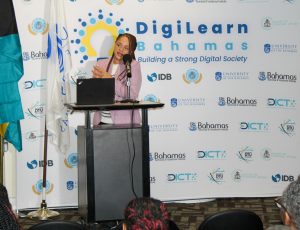
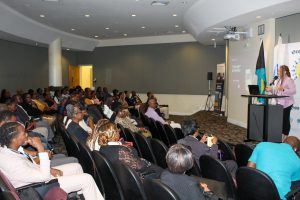
At a standing-room-only forum held at the Harry C. Moore Library auditorium, Cloud Carib Director of Marketing and Communications Olivia Dorsett argued that the nation’s biggest barrier isn’t access to technology, but paper-based rituals and “digital cosplay” that pull modern tasks back into outdated workflows, quietly imposing a “friction tax” in cost and security risk as global standards rise.
The event, “The Digital Shift: Embracing Technology in the Workplace”, was co-hosted by the University of The Bahamas (UB) and DigiLearn Bahamas, a national initiative designed to enhance digital literacy across the archipelago. The forum drew a diverse crowd of all ages, from university students and faculty to entrepreneurs, senior citizens, and veteran business leaders, reflecting the broad demographic impact of the digital revolution.
“The problem isn’t technology. It’s ritual,” Dorsett declared. “We keep calling friction ‘normal,’ and we pay for it every day: in time, in talent, and in trust.” She added, “Our biggest national export isn’t tourism. It’s time, and we waste it in lines, forms, and ‘come back tomorrow.’”
During the conversation, attendees learned from real-life experience, AI-supported research, and Cloud Carib’s own operational model to share tangible, scalable strategies that individuals, businesses, and governments can adopt immediately.
Cloud Carib, a leading regional provider of secure cloud infrastructure and managed IT services, continues to play a critical role in enabling digital transformation across the Caribbean. From helping governments modernize core systems to guiding enterprises through secure, scalable tech adoption, the company is a trusted partner in building digital resilience.
“We’re not behind because we’re a small country,” Dorsett emphasized. “We’re behind because we tolerate friction. But we don’t have to stay
there.”
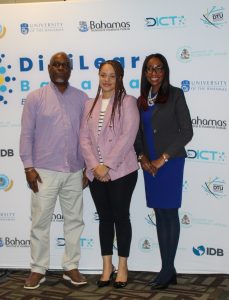
Dr. Willissa Mackey, Training Specialist at UB’s Private and Public Sector Training Department, emphasized the initiative’s role in creating an equitable future. “At the University of The Bahamas, we see digital literacy as a fundamental right. Through DigiLearn, we are redefining access and ensuring that no Bahamian, whether a student refining their resume or a grandmother learning online banking, is left behind in this digital revolution.”
The forum provided attendees with a practical framework for escaping legacy systems in favor of modern tools. By positioning a security-first mindset, attendees were urged to take personal ownership of the shift, arguing that modernization is not a government-only project, but a daily set of choices made by employees, managers, and students in how they communicate, document decisions, and protect information.