
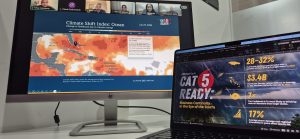
With climate-driven storms growing increasingly severe across the region, Caribbean businesses are being urged to radically shift their approach to disaster management. The warning came during “CAT 5 Ready: Business Continuity in the Eye of the Storm,” a critical regional webinar hosted by Cloud Carib Limited with guest panel contributions by CG Atlantic Insurance Agents & Brokers Ltd. and Structured Bahamas.
The forum arrived at a crucial time for the region. Historical data show that Caribbean economies lose an average of 17% of their GDP in years when a major hurricane makes landfall. Panelists pointed to the devastating impact of Hurricane Melissa in 2025, which cost Jamaica an estimated 28% to 32% of its GDP, as a stark reminder of how rapidly a single climate event can disrupt national productivity and halt economic recovery.
“Across the region, hurricane preparedness is still too often treated as just a facilities issue or an IT issue,” said Olivia Dorsett, Marketing Director of Cloud Carib. “The reality is that business resilience is a leadership issue. Organizations need to know whether their buildings can withstand the next storm, whether their data can be recovered, whether their teams can work, and whether their policies are adequate, when it matters most.”
Moderated by Michele Marius, Founder and Director of Jamaica-based ICT Pulse Consulting Limited, the panel challenged organizations to look past traditional checklists like shutters, generators, and emergency contacts to examine whether their broader systems and policies are genuinely ready to endure disruption.
On the topic of physical infrastructure and climate realities, Christopher Wells, Structural Engineer at Structured Bahamas, warned that many regional buildings rely on outdated codes or construction methods inadequate for today’s increasing wind, water, and storm-surge levels. He urged business owners to engage structural engineers early, before a storm enters the forecast, noting that contractors and supplies disappear once a watch is issued. Chaz Garraway, Climate Science Engineer, added that while storms may not always be growing more frequent, warmer ocean temperatures mean they are becoming significantly stronger, wetter, and more destructive, intensifying more rapidly and requiring businesses to build immediate redundancies into any single point of failure.
Addressing digital resilience, Mark Arruda, VP of Solutions at Cloud Carib, emphasized that technology is only half the battle, and true business continuity must account for the human element, explaining that while a business may have remote work capability, staff may still be dealing with power loss, internet outages at home, damaged residences, or unsafe conditions. To combat this, Arruda stressed that organizations must ruthlessly test disaster plans using tabletop exercises and live system replication. Cloud Carib’s sovereign cloud infrastructure demonstrated the power of this built-in redundancy by maintaining 100% uptime through both Hurricane Dorian in 2019 and Hurricane Melissa in 2025.
“Insurance is not something you want to get when you need it,” said Gabrielle McKenzie, Agency Manager at CG Atlantic Ltd., who closed the loop by addressing the financial realities of post-storm recovery, stating that incomplete documentation, underinsurance, and outdated asset valuations remain the leading causes of delayed or denied claims.
Together, the panelists reinforced one central message: hurricane preparedness cannot happen in silos, nor can it occur when a storm is en route. A business may have strong insurance but weak documentation. It may have modern IT systems, but no tested recovery process. True resilience requires all parts of the organisation to be aligned before the storm arrives.
The webinar is part of Cloud Carib’s ongoing regional effort to help Caribbean organizations strengthen their operational resilience, protect critical data, and modernize their business continuity strategies in the face of rising climate and cyber risks